START YOUR ONLINE
DEGREE TODAY
Associate of Applied Science in Magnetic Resonance Imaging (MRI) Technology
START YOUR ONLINE DEGREE TODAY
Associate of Applied Science in Magnetic Resonance Imaging (MRI) Technology
Comprehensive Curriculum
All lesson plans and syllabi are subject to change based upon program choice.

Transfer Credits
Your existing credits could accelerate your path to graduation and reduce your overall costs.

Ways to Save
Your professional, personal, and academic experiences might provide you with an advantage as you pursue your degree.

Apply Now
$25 application fee
No SAT/ACT
No essay required
Comprehensive Curriculum
All lesson plans and syllabi are subject to change based upon program choice.
Transfer Credits
Your existing credits could accelerate your path to graduation and reduce your overall costs.
Ways to Save
240 Clock Hours
Your professional, personal, and academic experiences might provide you with an advantage as you pursue your degree.
Apply Now
$25 application fee
No SAT/ACT
No essay required
Introduction
The Associate of Applied Science in Magnetic Resonance Imaging (MRI) Technology program prepares students for entry-level careers in diagnostic imaging through a combination of classroom instruction, laboratory practice, and supervised clinical experience. Students gain knowledge in anatomy, physiology, patient care, MRI physics, and imaging procedures while developing the technical and professional skills necessary to operate MRI equipment, ensure patient safety, and produce high-quality diagnostic images.
Summary
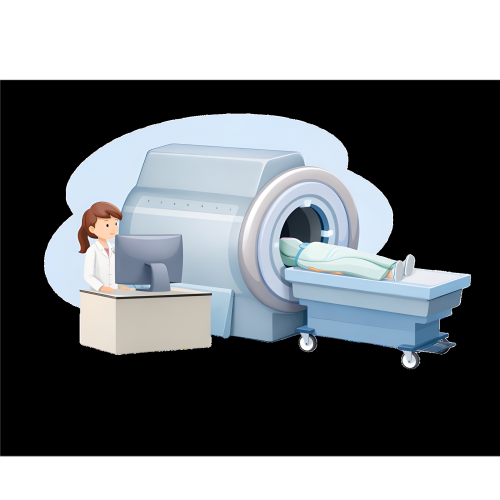
The Associate of Applied Science in Magnetic Resonance Imaging (MRI) Technology program provides students with the knowledge and hands-on training needed to perform MRI procedures in clinical settings. The curriculum emphasizes patient care, anatomy, MRI physics, safety practices, and imaging techniques, preparing graduates to produce high-quality diagnostic images and contribute effectively as healthcare professionals.

Objectives
To prepare students for post-program success by providing a rich learning environment utilizing research-based methods of instruction and providing access to relevant and current resources and materials. Students will participate in a challenging and worthwhile degree program based on current industry/academic expectations. The Associate of Applied Science in Magnetic Resonance Imaging (MRI) Technology program will provide students with a roadmap to gainful employment upon successful completion of 76 semester credit hours.
Introduction
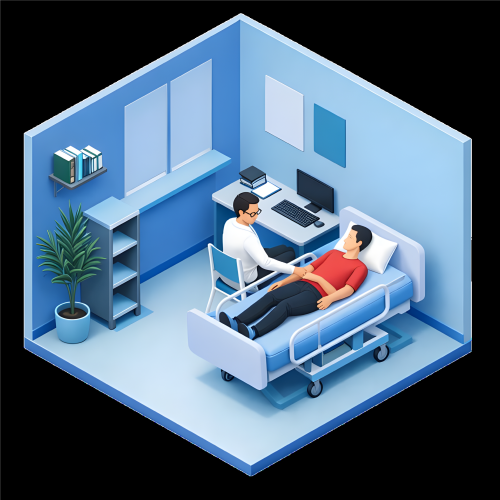
The Associate of Applied Science in Magnetic Resonance Imaging (MRI) Technology program prepares students for entry-level careers in diagnostic imaging through a combination of classroom instruction, laboratory practice, and supervised clinical experience. Students gain knowledge in anatomy, physiology, patient care, MRI physics, and imaging procedures while developing the technical and professional skills necessary to operate MRI equipment, ensure patient safety, and produce high-quality diagnostic images.
Summary
The Associate of Applied Science in Magnetic Resonance Imaging (MRI) Technology program provides students with the knowledge and hands-on training needed to perform MRI procedures in clinical settings. The curriculum emphasizes patient care, anatomy, MRI physics, safety practices, and imaging techniques, preparing graduates to produce high-quality diagnostic images and contribute effectively as healthcare professionals.
Objectives
To prepare students for post-program success by providing a rich learning environment utilizing research-based methods of instruction and providing access to relevant and current resources and materials. Students will participate in a challenging and worthwhile degree program based on current industry/academic expectations. The Associate of Applied Science in Magnetic Resonance Imaging (MRI) Technology program will provide students with a roadmap to gainful employment upon successful completion of 76 semester credit hours.
Courses
Browse courses for your Machine Learning Specialist diploma program
Education should be practical and relevant. That’s why our courses adhere to high academic standards and equip you with skills and knowledge that you can apply directly to your career.
Courses
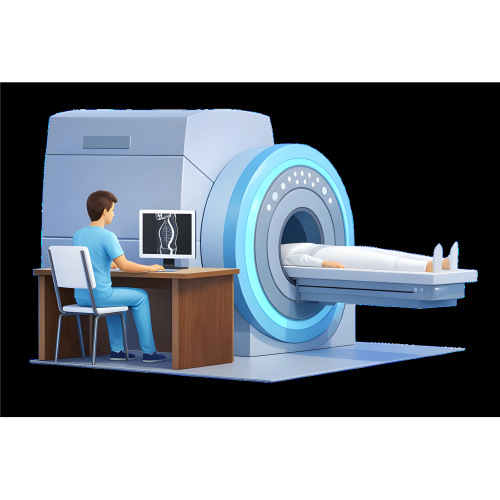
Browse courses for your MRI Technology Associate program
Education should be practical and relevant. That’s why our courses adhere to high academic standards and equip you with skills and knowledge that you can apply directly to your career.
Course Details
Course Format
- Instructor-led lectures
- Discussion/critique
- Interactive applications
- Virtual Lab time sessions
Assignments
Student Assessment and Grading
Aesthetic Evaluation
Technical Craftsmanship
Conceptual Evaluation
Software
Course Subjects
(76 credits)
General Education
COM-100 Introduction to Communication
4 Credit Hours
Prerequisite: None
This course is an introduction to the field of communication with emphasis on the history of communication study, concepts important to all areas of communication, the contexts in which communication occurs, and the issues that must be faced by students of communication. The course serves as an introduction to the strands of communication: interpersonal, small groups and teams, mass communication, organizational, intercultural, and rhetoric.
PSY-100 Introduction to Psychology
4 Credit Hours
Prerequisite: None
This course introduces the study of behavior and mental processes. Topics include brain and neuroscience, behavioral genetics, cognition, social and emotional development, perception, learning, memory, decision-making, language, consciousness, emotions, motivation, psychological disorders, social identity, interpersonal interactions, and cultural processes.
MAT-100 College Algebra
4 Credit Hours
Prerequisite: None
This course bridges the gap between high school mathematics and college-level mathematics and science courses. Topics include equations (linear, quadratic, conic, polynomial, exponential, logarithmic, and rational); graphing (inequalities, equations, functions, and relations); calculator use; and trigonometric functions and their applications.
ENC-100 English Composition
4 Credit Hours
Prerequisite: None
This course introduces students to professional writing, English diction, sentence structure, and rhetoric with emphasis on thesis or claim development. Students will study writing skills used in professional environments, including healthcare, focusing on academic texts, research, and documentation. The course emphasizes clarity, creativity, persuasion, and cooperative academic writing.
ENV-100 Environmental Science
4 Credit Hours
Prerequisite: None
This course is an interdisciplinary study of how humans interact with the environment. Topics include ecosystems, biodiversity, energy use, environmental policies, and sustainable practices. Students will examine environmental issues from scientific, social, and economic perspectives with an emphasis on problem-solving and critical thinking.
Technical Craftsmanship
Conceptual Evaluation
Software
Lab & Clinical Training
LAB-100 MRI Scanning Lab
3 Credit Hours
Prerequisite: None
This course utilizes the Corsmed simulator, allowing instructors to virtually train students on best practices for accurate slice alignment, contrast adjustment, and image sharpness through the resolution lab. Students will work on a virtual scanner console to apply knowledge gained in previous courses, gaining hands-on experience with simulated MRI scans.
MRI-501 Clinical Externship I
6 Credit Hours
Prerequisite: None
This course requires in-person attendance at clinical sites partnered with DSDT College. Students will work directly with patients under the supervision of licensed and registered MRI technologists. The course includes a minimum of 200 in-person clinical hours and 70 simulation hours delivered asynchronously, for a total of 270 clinical hours. Students must follow all clinical site policies and procedures, which may include site orientation and proof of COVID-19 vaccination.
MRI-502 Clinical Externship II
6 Credit Hours
Prerequisite: None
This clinical externship requires onsite attendance at affiliate imaging centers and hospitals. Students will participate in hands-on MRI training under the supervision of licensed MRI technologists. A minimum of 200 in-person hours and 70 simulation hours (totaling 270 clinical hours) is required, including at least 16 hours per week onsite. Students must follow all clinical site policies, which may include site orientation and COVID-19 vaccination requirements.
MRI-503 Clinical Externship III
8 Credit Hours
Prerequisite: None
This clinical externship requires onsite attendance at affiliate imaging centers and hospitals. Students will participate in hands-on MRI training under the supervision of licensed MRI technologists. A minimum of 265 in-person hours and 100 simulation hours (totaling 360 clinical hours) is required, including at least 16 hours per week onsite. Students must follow all clinical site policies, which may include site orientation and COVID-19 vaccination requirements.
Professional & Ethical Foundations
MRI-402 Medical Ethics, Law, and Cultural Diversities
3 Credit Hours
Prerequisite: None
This course introduces medical ethics, law, and cultural diversity for healthcare personnel. Students will explore criminal and civil law, contracts, negligence, ethical principles, patient rights, and cultural competence as they relate to medical imaging practice.
Core MRI Courses
MRI-100 Patient Care and MRI Safety
3 Credit Hours
Prerequisite: None
This course provides an introduction to healthcare for MRI professionals. Students will learn basic medical care practices, infection control fundamentals, and MRI safety principles. The course prepares students for real-life patient interactions.
MRI-102 Medical Technology
3 Credit Hours
Prerequisite: None
This course develops students’ understanding of medical terminology in relation to the human body. Students will learn to recognize, understand, and correctly use medical terms through reinforcement exercises and clear explanations.
MRI-103 Anatomy and Physiology
3 Credit Hours
Prerequisite: None
This course develops students’ understanding of the structure and function of the human body, including cells, tissues, and organs, with a focus on the skeletal, muscular, nervous, sensory, cardiovascular, digestive, urinary, and reproductive systems. Emphasis is placed on interrelationships among systems and regulation of physiological functions to maintain homeostasis.
MRI-200 Fundamental of MRI Physics
3 Credit Hours
Prerequisite: None
This course focuses on the fundamental principles of MRI physics, providing a foundation for understanding the physical properties of magnetic fields, electrical currents, and relaxation times.
MRI-201 Sectional Anatomy
3 Credit Hours
Prerequisite: None
This course provides a comprehensive, easy-to-understand approach to sectional anatomy of the human body. Students advance from general anatomy and physiology to cross-sectional imaging, developing the ability to identify anatomical structures in planes commonly used in MRI.
MRI-203 Pulse Sequence Design and Parameters
3 Credit Hours
Prerequisite: None
This course focuses on the mechanical timing of pulse sequences and parameters during MRI examinations. Students learn to understand the operational choices an MRI technologist must make for each imaging sequence and their impact on image quality and clinical outcomes.
MRI-300 MRI Procedures
3 Credit Hours
Prerequisite: None
This course provides an in-depth overview of imaging each body part according to generalized MRI protocols and clinician focus. Students develop knowledge of scan angulations, relevant anatomy, and adjustments for anatomical anomalies to optimize image quality and diagnostic accuracy.
MRI-301 MR Equipment and Image Acquisition
3 Credit Hours
Prerequisite: MRI 200, MRI 203
This course provides a comprehensive overview of the hardware and software components of the MRI unit. Students will develop knowledge of mechanical processes and understand how raw data is transformed into diagnostic MRI images for interpretation by a radiologist.
MRI-400 MRI Procedures II
3 Credit Hours
Prerequisite: MRI 200, MRI 203
This course provides a concise introduction to the fundamentals of pathophysiology, focusing on essential major organs, diseases, and disorders within the human body. Students will understand how diseases affect organ system functions and the overall human body, preparing them to recognize pathological conditions relevant to MRI practice.
MRI-401 Troubleshooting MRI Artifacts
3 Credit Hours
Prerequisite: MRI 200, MRI 203
This course focuses on MRI artifacts and the underlying physics. Students will identify, analyze, and discuss common artifacts seen in MR imaging. Emphasis is placed on understanding causes, operator-controlled variables, and techniques to minimize or eliminate artifacts to optimize image quality.
Requirements:
A basic understanding of technology is recommended, but no prior experience is needed to enroll.
Gadgets
Personal Computer with stable access to internet (highly recommended)
Specifications
8-16GB USB Flash Drive or Portable USB or FireWire Hard Drive and Dropbox account (Highly recommended)
Other materials
Notebook and/or sketch book
Course Details
Course Format
- Instructor-led lectures
- Discussion/critique
- Interactive applications
- Virtual Lab time sessions
Assignments
Student Assessment and Grading
Aesthetic Evaluation
Technical Craftsmanship
Conceptual Evaluation
Software
Course Subjects (76 credits)
General Education
COM-100 Introduction to Communication
4 Credit Hours
Prerequisite: None
This course is an introduction to the field of communication with emphasis on the history of communication study, concepts important to all areas of communication, the contexts in which communication occurs, and the issues that must be faced by students of communication. The course serves as an introduction to the strands of communication: interpersonal, small groups and teams, mass communication, organizational, intercultural, and rhetoric.
PSY-100 Introduction to Psychology
4 Credit Hours
Prerequisite: None
This course introduces the study of behavior and mental processes. Topics include brain and neuroscience, behavioral genetics, cognition, social and emotional development, perception, learning, memory, decision-making, language, consciousness, emotions, motivation, psychological disorders, social identity, interpersonal interactions, and cultural processes.
MAT-100 College Algebra
4 Credit Hours
Prerequisite: None
This course bridges the gap between high school mathematics and college-level mathematics and science courses. Topics include equations (linear, quadratic, conic, polynomial, exponential, logarithmic, and rational); graphing (inequalities, equations, functions, and relations); calculator use; and trigonometric functions and their applications.
ENC-100 English Composition
4 Credit Hours
Prerequisite: None
This course introduces students to professional writing, English diction, sentence structure, and rhetoric with emphasis on thesis or claim development. Students will study writing skills used in professional environments, including healthcare, focusing on academic texts, research, and documentation. The course emphasizes clarity, creativity, persuasion, and cooperative academic writing.
ENV-100 Environmental Science
4 Credit Hours
Prerequisite: None
This course is an interdisciplinary study of how humans interact with the environment. Topics include ecosystems, biodiversity, energy use, environmental policies, and sustainable practices. Students will examine environmental issues from scientific, social, and economic perspectives with an emphasis on problem-solving and critical thinking.
Lab & Clinical Training
LAB-100 MRI Scanning Lab
3 Credit Hours
Prerequisite: None
This course utilizes the Corsmed simulator, allowing instructors to virtually train students on best practices for accurate slice alignment, contrast adjustment, and image sharpness through the resolution lab. Students will work on a virtual scanner console to apply knowledge gained in previous courses, gaining hands-on experience with simulated MRI scans.
MRI-501 Clinical Externship I
6 Credit Hours
Prerequisite: None
This course requires in-person attendance at clinical sites partnered with DSDT College. Students will work directly with patients under the supervision of licensed and registered MRI technologists. The course includes a minimum of 200 in-person clinical hours and 70 simulation hours delivered asynchronously, for a total of 270 clinical hours. Students must follow all clinical site policies and procedures, which may include site orientation and proof of COVID-19 vaccination.
MRI-502 Clinical Externship II
6 Credit Hours
Prerequisite: None
This clinical externship requires onsite attendance at affiliate imaging centers and hospitals. Students will participate in hands-on MRI training under the supervision of licensed MRI technologists. A minimum of 200 in-person hours and 70 simulation hours (totaling 270 clinical hours) is required, including at least 16 hours per week onsite. Students must follow all clinical site policies, which may include site orientation and COVID-19 vaccination requirements.
MRI-503 Clinical Externship III
8 Credit Hours
Prerequisite: None
This clinical externship requires onsite attendance at affiliate imaging centers and hospitals. Students will participate in hands-on MRI training under the supervision of licensed MRI technologists. A minimum of 265 in-person hours and 100 simulation hours (totaling 360 clinical hours) is required, including at least 16 hours per week onsite. Students must follow all clinical site policies, which may include site orientation and COVID-19 vaccination requirements.
Professional & Ethical Foundation
MRI-402 Medical Ethics, Law, and Cultural Diversities
3 Credit Hours
Prerequisite: None
This course introduces medical ethics, law, and cultural diversity for healthcare personnel. Students will explore criminal and civil law, contracts, negligence, ethical principles, patient rights, and cultural competence as they relate to medical imaging practice.
Core MRI Courses
MRI-100 Patient Care and MRI Safety
3 Credit Hours
Prerequisite: None
This course provides an introduction to healthcare for MRI professionals. Students will learn basic medical care practices, infection control fundamentals, and MRI safety principles. The course prepares students for real-life patient interactions.
MRI-102 Medical Technology
3 Credit Hours
Prerequisite: None
This course develops students’ understanding of medical terminology in relation to the human body. Students will learn to recognize, understand, and correctly use medical terms through reinforcement exercises and clear explanations.
MRI-103 Anatomy and Physiology
3 Credit Hours
Prerequisite: None
This course develops students’ understanding of the structure and function of the human body, including cells, tissues, and organs, with a focus on the skeletal, muscular, nervous, sensory, cardiovascular, digestive, urinary, and reproductive systems. Emphasis is placed on interrelationships among systems and regulation of physiological functions to maintain homeostasis.
MRI-200 Fundamental of MRI Physics
3 Credit Hours
Prerequisite: None
This course focuses on the fundamental principles of MRI physics, providing a foundation for understanding the physical properties of magnetic fields, electrical currents, and relaxation times.
MRI-201 Sectional Anatomy
3 Credit Hours
Prerequisite: None
This course provides a comprehensive, easy-to-understand approach to sectional anatomy of the human body. Students advance from general anatomy and physiology to cross-sectional imaging, developing the ability to identify anatomical structures in planes commonly used in MRI.
MRI-203 Pulse Sequence Design and Parameters
3 Credit Hours
Prerequisite: None
This course focuses on the mechanical timing of pulse sequences and parameters during MRI examinations. Students learn to understand the operational choices an MRI technologist must make for each imaging sequence and their impact on image quality and clinical outcomes.
MRI-300 MRI Procedures
3 Credit Hours
Prerequisite: None
This course provides an in-depth overview of imaging each body part according to generalized MRI protocols and clinician focus. Students develop knowledge of scan angulations, relevant anatomy, and adjustments for anatomical anomalies to optimize image quality and diagnostic accuracy.
MRI-301 MR Equipment and Image Acquisition
3 Credit Hours
Prerequisite: MRI 200, MRI 203
This course provides a comprehensive overview of the hardware and software components of the MRI unit. Students will develop knowledge of mechanical processes and understand how raw data is transformed into diagnostic MRI images for interpretation by a radiologist.
MRI-400 MRI Procedures II
3 Credit Hours
Prerequisite: MRI 200, MRI 203
This course provides a concise introduction to the fundamentals of pathophysiology, focusing on essential major organs, diseases, and disorders within the human body. Students will understand how diseases affect organ system functions and the overall human body, preparing them to recognize pathological conditions relevant to MRI practice.
MRI-401 Troubleshooting MRI Artifacts
3 Credit Hours
Prerequisite: MRI 200, MRI 203
This course focuses on MRI artifacts and the underlying physics. Students will identify, analyze, and discuss common artifacts seen in MR imaging. Emphasis is placed on understanding causes, operator-controlled variables, and techniques to minimize or eliminate artifacts to optimize image quality.
Requirements:
A basic understanding of technology is recommended, but no prior experience is needed to enroll.
Gadgets
Personal Computer with stable access to internet (highly recommended)
Specifications
8-16GB USB Flash Drive or Portable USB or FireWire Hard Drive and Dropbox account (Highly recommended)
Other materials
Notebook and/or sketch book
Schedule
Check out our schedule to find available class times that fit your routine. Your academic counselor will assist you in planning your courses for the MRI Technology Associate program.
Schedule
Check out our schedule to find available class times that fit your routine. Your academic counselor will assist you in planning your courses for the MRI Technology Associate program.

Acquire career-relevant skills in a matter of weeks, not years.
Learning shouldn’t be delayed for years before you can apply it. That’s why we empower you to develop career-relevant skills through our five- to six-week courses.
Acquire career-relevant skills in a matter of weeks, not years.
Learning shouldn’t be delayed for years before you can apply it. That’s why we empower you to develop career-relevant skills through our five- to six-week courses.
Tuition
Breakdown and Payment Policies
The tuition and fees for the MRI Technology Associate Program total $23,000, which breaks down to $302.63 per clock hour for 76 clock hours.
Tuition
Breakdown and Payment Policies
The tuition and fees for the MRI Technology Associate Program total $23,000, which breaks down to $302.63 per clock hour for 76 clock hours.

Transparent, fixed tuition
Enjoy peace of mind with fixed tuition, ensuring a consistent rate from enrollment to graduation. This is your Tuition Guarantee.

Attendance
Attendance on a daily basis is a mandatory requirement for all students. Any class session or activity missed, regardless of cause, reduces the opportunity for learning and may adversely affect a student’s achievement. Students are responsible to instructors for class attendance and for any class work missed during an absence. Student is responsible to catch up on the missing material on his/her own by contacting fellow classmates or instructor.
Transparent, fixed tuition
Enjoy peace of mind with fixed tuition, ensuring a consistent rate from enrollment to graduation. This is your Tuition Guarantee.
Attendance
Attendance on a daily basis is a mandatory requirement for all students. Any class session or activity missed, regardless of cause, reduces the opportunity for learning and may adversely affect a student’s achievement. Students are responsible to instructors for class attendance and for any class work missed during an absence. Student is responsible to catch up on the missing material on his/her own by contacting fellow classmates or instructor.
Careers
What career opportunities are available with an Associate of Applied Science degree focusing on MRI Technology?
Explore the potential career paths enabled by your degree and make well-informed decisions about your future.
This program will prepare you to become a(n):
MRI Technologist
Radiologic Technologist
MRI Clinical Specialist
MRI Applications Specialist
Lead MRI Technologist / Supervisor
Top skills learned in this program:
MRI Scanning & Imaging Techniques
Patient Care & Safety
MRI Physics & Pulse Sequence Design
Anatomy & Physiology
Image Acquisition & Troubleshooting
Careers
What career opportunities are available with an Associate of Applied Science degree focusing on MRI Technology?
Explore the potential career paths enabled by your degree and make well-informed decisions about your future.
This program will prepare you to become a(n):
MRI Technologist
Radiologic Technologist
MRI Clinical Specialist
MRI Applications Specialist
Lead MRI Technologist / Supervisor
Top skills learned in this program:
MRI Scanning & Imaging Techniques
Patient Care & Safety
MRI Physics & Pulse Sequence Design
Anatomy & Physiology
Image Acquisition & Troubleshooting

Did you know?
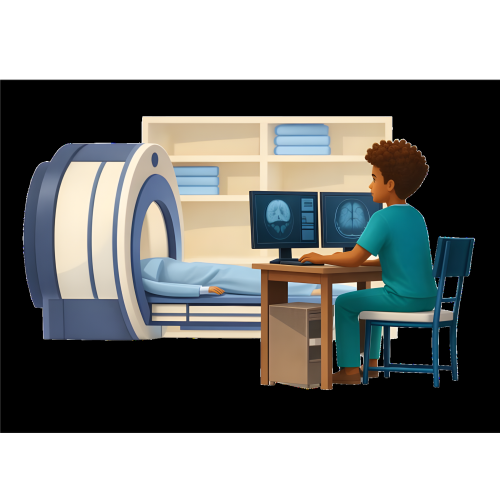
The demand for MRI technologists is growing rapidly, and these professionals operate powerful, radiation-free machines that align hydrogen atoms in the body—providing safe, detailed images without invasive procedures.
Did you know?
The demand for MRI technologists is growing rapidly, and these professionals operate powerful, radiation-free machines that align hydrogen atoms in the body—providing safe, detailed images without invasive procedures.
Admission
Apply now – $25 application fee, no commitment required.
Embarking on your degree is a significant decision, and we aim to streamline your application process by removing any obstacles.
No SAT/ACT required
No essay required
We’ll request transcripts at no cost to you, when possible, and we accept eligible credits from over 5,000 accredited institutions.

Admission
Apply now – $25 application fee, no commitment required.
Embarking on your degree is a significant decision, and we aim to streamline your application process by removing any obstacles.
No SAT/ACT required
No essay required
We’ll request transcripts at no cost to you, when possible, and we accept eligible credits from over 5,000 accredited institutions.
Learner Experience
An education that fits your busy life
Online learning
Enroll in online classes and attend class whenever it fits your life, day or night.
Around-the-clock support and resources
You have access to our support team for up to 14 hours a day, 5 days a week.
Learning Structure
76 Clock Hours – Core Curriculum
Learning Outcome
Each week will feature an interactive assignment and/or project that illustrates the section they have learned.

Learner Experience
An education that fits your busy life
Online learning
Enroll in online classes and attend class whenever it fits your life, day or night.
Around-the-clock support and resources
You have access to our support team for up to 14 hours a day, 5 days a week.
Learning Structure
76 Clock Hours – Core Curriculum
Learning Outcome
Each week will feature an interactive assignment and/or project that illustrates the section they have learned.
Accrediation
Count on the quality of your education
DSDT is accredited by the Commission of the Council on Occupational Education.

Accreditation
Count on the quality of your education
DSDT is accredited by the Commission of the Council on Occupational Education.
Our Programs
Machine Learning Specialist
AI Prompt Specialist

Digital Marketing Professional
Full Stack Developer

Business Information Technology Specialist
Associate of Applied Science in Information Technology
Technology Professional 2
Technology Professional 6

Career Skills Program (CSP)
MRI Technology Associate
VET TECH 2.0
Testimonials
See what our students are saying.
Student Grievance Process for the National Council for State Authorization Reciprocity Agreements.
DSDT College is accredited by the Commission of the Council on Occupational Education.
CONTACT US
Main Campus
1759 W. 20th Street
Detroit, MI 48216
CSP TRAINING
Lone Star Conference Center
Business Division, Family DFMWR
Bldg. 5764, 24th Street And Wainwright Drive
Fort Hood, TX 76544
HAVE QUESTIONS?
WE'RE HERE TO HELP!
If you have questions about completing your application or want to know more about starting classes, please don’t hesitate to reach out to us. Our dedicated team is here to assist you every step of the way.
Copyright © 2025 DSDT College - All Rights Reserved | Privacy Policy | Terms of Use | Non-Discrimination Policy


Student Grievance Process for the National Council for State Authorization Reciprocity Agreements.
DSDT College is accredited by the Commission of the Council on Occupational Education.
CONTACT US
Main Campus
1759 W. 20th Street
Detroit, MI 48216
CSP TRAINING
Lone Star Conference Center
Business Division, Family DFMWR
Bldg. 5764, 24th Street And Wainwright Drive
Fort Hood, TX 76544
HAVE QUESTIONS?
WE'RE HERE TO HELP!
If you have questions about completing your application or want to know more about starting classes, please don’t hesitate to reach out to us. Our dedicated team is here to assist you every step of the way.
Copyright © 2025 DSDT College - All Rights Reserved | Privacy Policy | Terms of Use | Non-Discrimination Policy